Bold, Geometric Art for Living Room: A Practical Styling Guide for Creating Statement Walls
Table of Content
Every living room has one defining wall – the surface your eye is drawn to the moment you step inside. It may sit behind the sofa, opposite the seating area, or frame a fireplace or media unit. Often, however, it remains curiously blank. As both an abstract artist and an architect, I see this not as empty space but as unrealised potential. That wall is ready for a statement piece – bold geometric wall art powerful enough to anchor the entire room, confident enough to spark conversation, and striking enough to transform your living space from merely pleasant to truly memorable.
Unlike decorative pieces that quietly blend into the background, statement art commands attention. It does not whisper from the wall – it leads the room. In spaces where you relax, gather with family, and entertain guests, that visual authority changes not only how the room looks, but how it feels and functions.
This guide is designed for homeowners, renters, interior design enthusiasts, property developers, and anyone seeking to elevate their living room with confidence and clarity. Geometric art for living room decor matters, because of its ability to create a modern, balanced look. Whether you are styling a contemporary flat, a period home, or a newly built house, it will help you choose, position and scale bold geometric art in a way that feels intentional rather than overwhelming. By the end, you will understand not only how to hang geometric art, but how to use it strategically – as an architectural tool that defines space, sets mood and expresses personality.
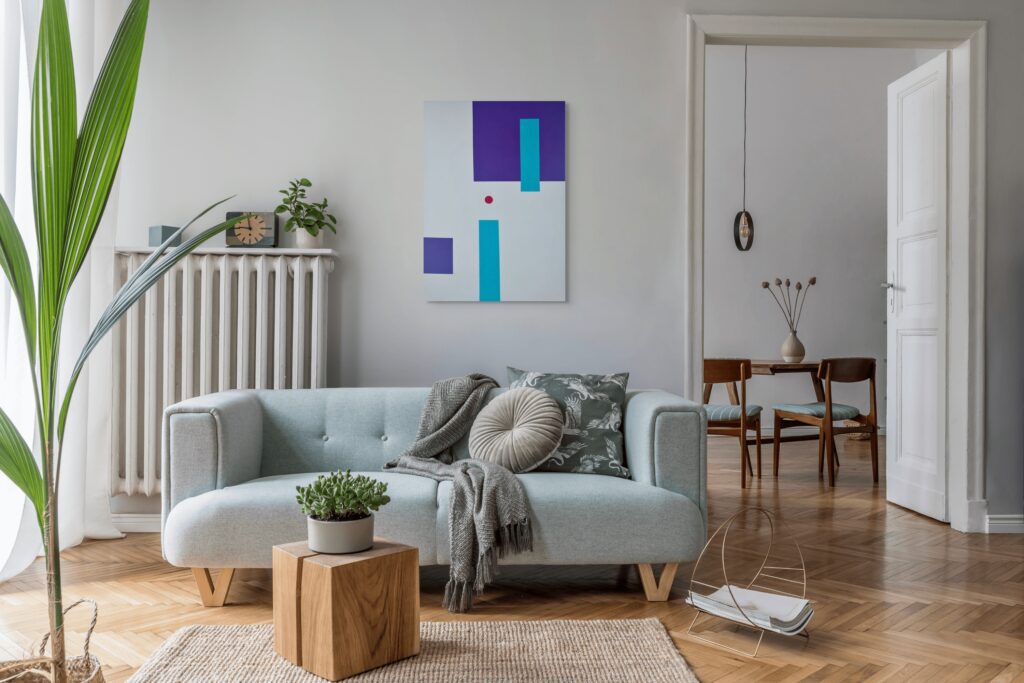
Geometric Art Styles, Influences, and Trends
Geometric art spans a wide range of styles, each bringing its own visual language and impact to modern interiors.
#1 Historical and Modern Movements
The 1920s German school style and Bauhaus both use primary colours and basic shapes like circles, squares and triangles to create structured, clean compositions, with Bauhaus famously following the ‘form follows function’ philosophy. De Stijl, pioneered by Piet Mondrian, focuses on vertical and horizontal lines with primary colour blocks, while Agnes Martin’s delicate, grid-based patterns offer a calming, minimalist effect. Hard-edge painting emphasises abrupt transitions between colour areas and sharp lines, creating a precise, graphic aesthetic.
#2 Op Art and Optical Exploration
Op Art, led by artists such as Bridget Riley, uses hypnotic geometric patterns to create optical illusions, producing striking conversation pieces. Kevin Jackson and Sumit Mehndiratta expand this approach with subtle or layered compositions that play with perspective and depth.
#3 Minimalist and Contemporary Geometric Art
Minimalist geometric art maintains calm through simple shapes and limited palettes, exemplified by artists such as Frank Stella and Charlie Oscar Patterson. Charlie Oscar Patterson is known for minimalist sculptures and paintings featuring bold, block colours. Ellsworth Kelly’s bold shapes and colours and Donald Judd’s sculptural, 3D forms bring strong visual presence to modern spaces. Sarah Morris creates large-scale geometric paintings inspired by architecture, while Olivia Peake creates geometric paintings and installations using light-reflective films. Very interesting is Kevin Jackson who produces prints characterized by subtle, often monochromatic, hypnotic shape formations.
#4 Organic Modern and Its Coastal Geometric Interpretations
The organic modern aesthetic emphasises natural colours, textures, and layered surfaces to create a warm, inviting atmosphere. Coastal geometric art can be seen as a specialised offshoot of this approach, translating these natural inspirations into geometric forms and colours drawn from sunsets, ocean hues, and sandy landscapes. Coastal geometric art pieces often feature organic and abstract shapes. Organic modern focuses on overall texture and comfort, coastal geometric applies that ethos specifically to art, creating pieces that bring a breezy, relaxed feel to minimalist or coastal-themed interiors.
#5 Influential Artists and Inspirations
Wassily Kandinsky’s later work combines vibrant graphics with abstract spiritualism, adding intellectual and emotional depth to interiors. Josef Müller-Brockmann contributes through his poster-style graphic art, while Piet Mondrian’s grid-based abstractions remain iconic for modern minimalism.
#6 Current Trends for 2026
A leading trend blends 1920s Art Deco elements, such as sharp angles and zigzags, with contemporary colour palettes. Key elements of the 2026 trend include rich tones such as forest green and indigo paired with metallic accents like brass. Rich tones and metallic accents in decor create a ‘luxurious but in moderation’ feel in modern living spaces. Beyond the walls, bold geometric rugs can act as foundational elements, providing spatial structure and visual order in the living room.
This rich diversity of styles, from historic schools to modern innovations, demonstrates that geometric art can suit any interior, offering rhythm, structure, and visual impact while remaining adaptable to personal taste. Let’s read how it works in living room in next section.
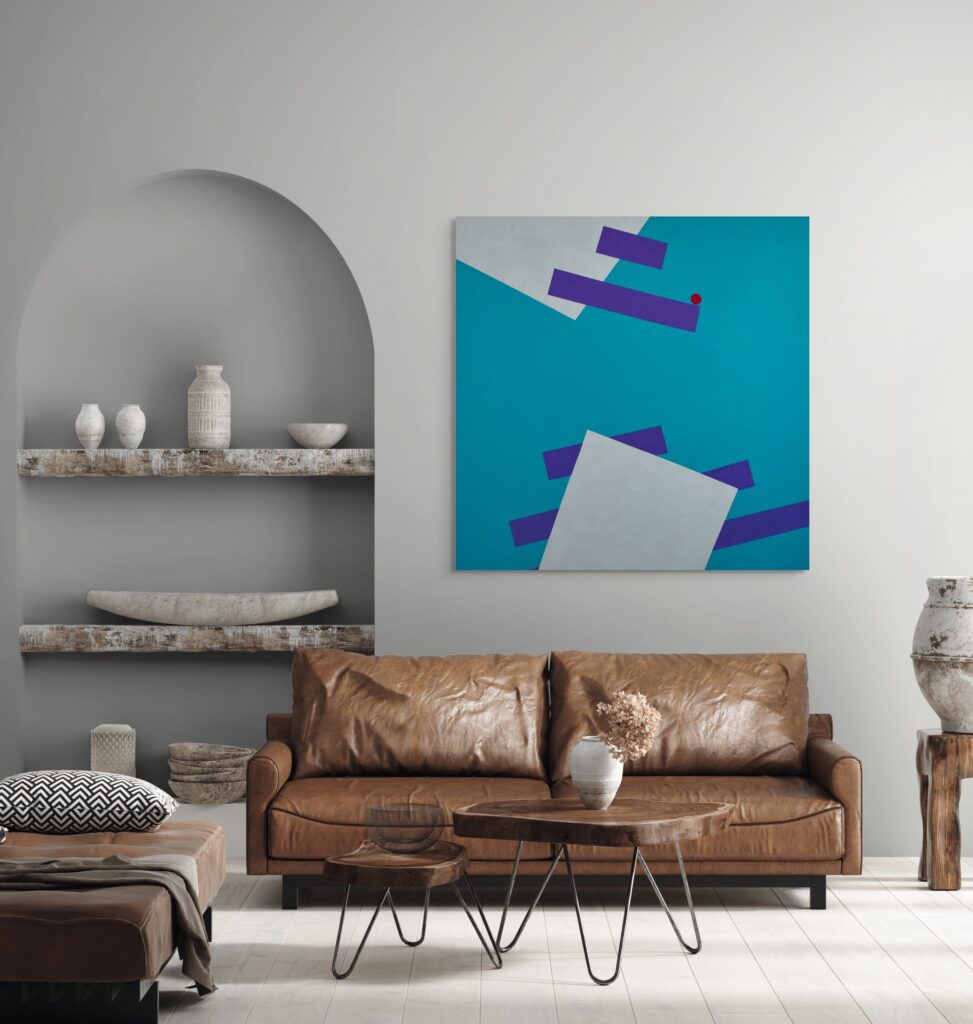
Introduction to Abstract Geometric Art for Living Room
Clean lines, deliberate angles and confident colour placement can transform a flat surface into an architectural focal point. In the living room, the most social and expressive space in the home, bold geometric art has the power to structure the room visually, much like a well-designed façade defines a building.
Whether you are refining a modern flat, updating a Victorian terrace or styling a new-build house, you will learn how to choose the right scale, position artwork correctly, balance colour, and create a statement wall that feels cohesive rather than overwhelming.
With these foundations in place, it becomes clear that geometric art is more than a stylistic preference – it is a design tool. To understand why it integrates so seamlessly into modern homes, we must first examine the relationship between geometry and contemporary interiors in next section.
Why Geometric Wall Art Works in Contemporary Interiors
Geometric shapes bring order. Circles soften, squares stabilise, triangles energise, and strong vertical or horizontal lines introduce rhythm. In a living room filled with sofas, cushions and layered textures, geometry provides visual balance. It creates structure against softer furnishings and prevents the space from feeling undefined or cluttered.
This sense of order is precisely why geometric art pairs so naturally with contemporary interiors. Modern design favours clean silhouettes, open layouts and architectural clarity. A bold geometric canvas above a 2.4–3 meter (8–10 ft) wide sofa reinforces symmetry, while a structured triptych spanning 150–220 cm (60–87 in) can visually widen a narrower wall. Large-scale art is recommended for maximum impact in open-plan living areas.
For visual inspiration, imagine:
- A large circular composition echoing a round coffee table.
- Strong vertical line work complementing floor-to-ceiling curtains.
- A grid-based abstract piece reinforcing the clean lines of a modular sofa.
Having explored the design principles behind geometric art, we will now look at what makes certain pieces truly impactful, including scale, composition, colour strength and presence.
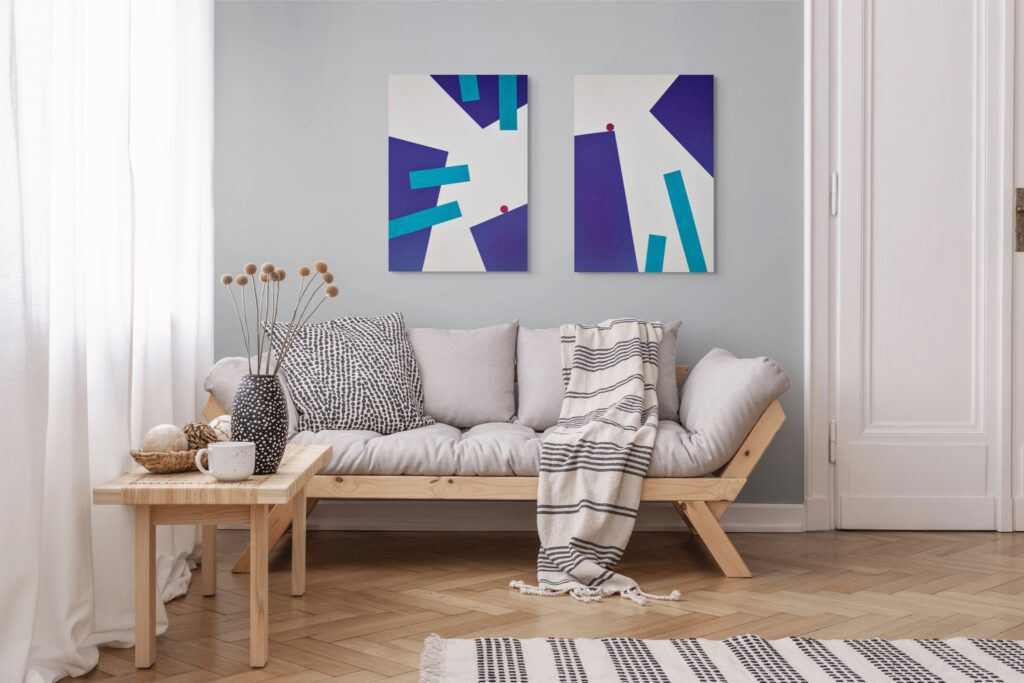
What Makes Geometric Art Impactful
Not all geometric art creates a statement. Truly bold pieces possess distinct qualities that elevate them from decorative accessories to defining features.
#1 Scale and Presence: Large Geometric Canvas Dimensions
Impact begins with scale. A single-panel statement canvas typically measures at least 120 cm (48 in) in width, while more dramatic pieces range between 150–200 cm (60–79 in). Multi-panel sets or triptychs often span 180–230 cm (71–90 in), making them ideal for larger living rooms with ceilings above 2.4 metres (8 ft). Geometric art is available in both landscape and portrait orientations. Choosing a portrait orientation can be especially effective for tall, narrow walls or to create a sense of height in the living room.
This is not artwork intended to “fill a gap”. It is designed to anchor a room. The physical presence alone commands attention, yet size without intention is ineffective. A large canvas in muted tones can fade into the background. True boldness combines generous scale with strong geometric structure and confident colour.
#2 Geometric Pattern and Abstract Line Art in Modern Compositions
Bold geometric art uses colour decisively. Deep indigo, saturated teal, burnt orange, architectural black or layered neutrals create contrast that reads clearly from across the room. The structured nature of geometric shapes intensifies this effect, amplifying colour through sharp boundaries and defined edges.
Strong abstract compositions establish hierarchy and movement. Your eye understands immediately where to look and how to travel across the piece. Minimalist geometric designs achieve clarity through restraint and deliberate line work, while more complex modern abstract works balance layered forms with legibility.
When positioned 15–25 cm (6–10 in) above a sofa back or centred at approximately 145–150 cm (57–59 in) from the floor to the artwork’s midpoint (standard gallery height), the piece integrates seamlessly into the architecture of the space.
#3 The Confidence Factor: The Appeal of Geometry in Modern Minimalist Design
Bold art reflects certainty – both in the artist’s vision and in the homeowner’s styling decisions. Geometry, by nature, is precise and unapologetic. Clean lines do not hesitate, strong shapes do not blend timidly into the background.
This quiet confidence is what separates modern geometric wall art from oversized decoration. It feels deliberate, architectural and composed. In minimalist interiors especially, where restraint defines the aesthetic, a single strong geometric painting can provide focus without clutter.
For living rooms seeking modern elegance, geometric works featuring a distinctive focal element – such as a carefully placed accent or signature mark – add personality without compromising clarity. When chosen thoughtfully, they do not compete with the space, they complete it.
Understanding these principles allows you to move beyond simply choosing art you “like” and towards selecting art that transforms your living room into a cohesive, statement-making environment.
With a clear understanding of impact and presence, the following section moves into practical guidance on how to choose the right geometric art prints for your living room, covering proportion, placement and coordination with your existing décor.
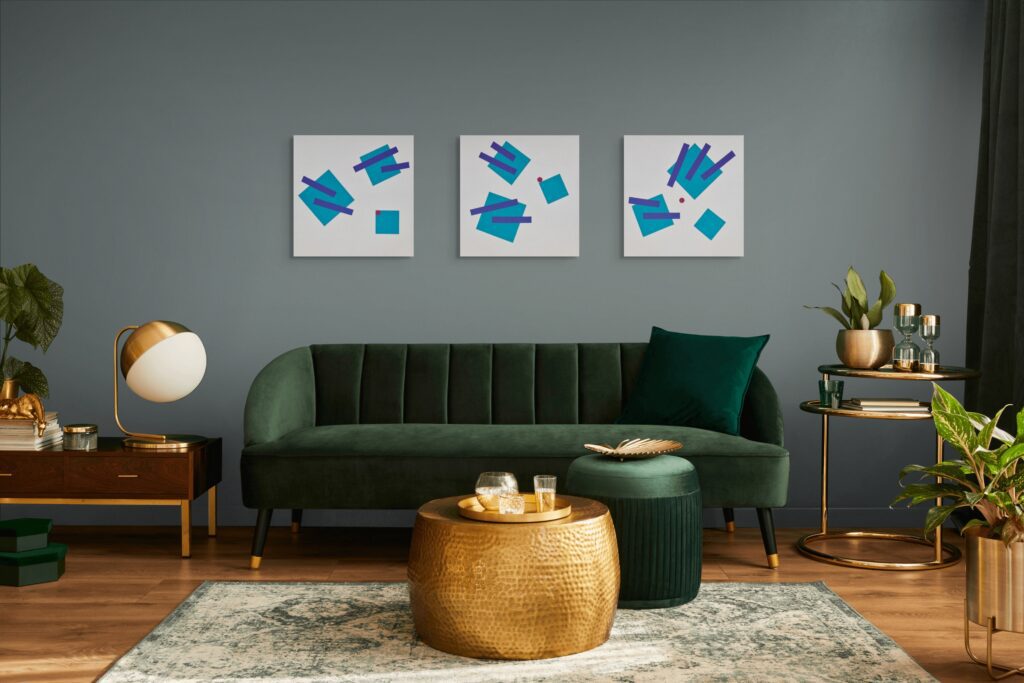
Choosing Geometric Wall Art for the Living Room
Selecting geometric wall art is not simply about finding a design you like. It involves assessing proportion, colour balance, material quality and budget with the same care you would apply to furniture or lighting. A statement wall succeeds when the artwork feels intentional – scaled correctly, harmonised with the palette, and produced to a standard that will endure.
Before purchasing, consider three essential decision factors: size and scale, colour and mood, and material and finish. Alongside these, set a realistic budget range. For high-quality large-format prints (120–180 cm / 48–71 in), prices typically range from £150–£600 (€175–€690 / $190–$750), depending on materials and framing. Original paintings by emerging or established artists may begin around £800 (€920 / $1,000) and extend into several thousand pounds or dollars, depending on scale and reputation.
When browsing for geometric art for your living room, many online shops offer filters to help you narrow down options by size, colour, orientation, material, and more. You can also filter to show only pieces currently in stock, making it easier to shop for art that is available for immediate purchase.
You should also decide whether to invest in an original artwork or a print. Originals offer texture, individuality and long-term value. Limited-edition prints provide accessibility while maintaining exclusivity. Open-edition prints are more affordable but should still be produced with archival standards. With these broader considerations in mind, the first and most critical factor to address is scale, size and proportions.
#1 Size, Scale and Proportions for Living Room Walls
Scale is the foundation of a successful statement wall. Even the boldest geometric composition will lose its authority if it is too small – and will feel oppressive if oversized. Proportion must work with your furniture, ceiling height and viewing distance.
#1.1 The Two-Thirds Rule for Above-Sofa Placement
As a general guideline, artwork should measure 60–75% of the width of the furniture beneath it.
For example:
- A 240 cm (94 in) sofa pairs well with artwork approximately 145–180 cm (57–71 in) wide.
- A 213 cm (84 in) sofa suits artwork around 140 cm (56 in) wide.
- A 244 cm (96 in) sectional benefits from at least 160 cm (64 in) of visual width.
💡 Tip: When in doubt, slightly larger is usually better than too small – undersized art is the most common styling mistake.
Single-panel canvases typically begin at 120 cm (48 in) wide for real presence. Triptychs or multi-panel sets often span 180–220 cm (71–87 in), offering generous impact without requiring one oversized piece.
#1.2 Measuring the Wall Properly
Before purchasing, measure carefully:
- Wall width and height
- Sofa width and height
- Ceiling height
- Distance from seating to wall
For positioning:
- Centre the artwork at approximately 145–150 cm (57–59 in) from floor to midpoint (standard gallery height).
- Leave 15–25 cm (6–10 in) between the sofa back and the bottom of the artwork.
Standard 2.4 m (8 ft) ceilings comfortably accommodate pieces up to 150 cm (59 in) tall.
With 3 m (10 ft) ceilings or higher, you can introduce taller vertical compositions 160–180 cm (63–71 in) without overwhelming the room.
Equally important is breathing space. Avoid crowding bold geometric work with shelves, mirrors or wall lights. Negative space enhances architectural clarity.
💡 Tip: Tape the outline of the artwork on the wall before buying. It instantly reveals whether the scale feels balanced.
#1.3 Triptychs and Multi-Panel Solutions
Three-panel artworks are particularly effective for living rooms. For instance:
- A 180 cm (72 in) wide triptych may consist of three 60 cm (24 in) panels.
- Spacing of 3–5 cm (1–2 in) between panels creates rhythm and lightness.
Advantages of triptychs include:
- Easier transport and installation
- Flexibility in spacing
- A sense of movement and architectural repetition
The subtle gaps between panels add visual breathing room while maintaining strong overall width. This format works especially well with geometric line compositions, where repetition enhances structure.
#1.4 Vertical Dimension and Viewing Distance
Height matters as much as width. Most statement pieces require:
- 75–120 cm (30–48 in) vertical dimension for effective presence.
- For standard 8 ft ceilings: ideally 90–100 cm (36–40 in) high.
- For 10 ft ceilings and above: taller formats become viable.
Also consider viewing distance:
- If your sofa sits 3.5–4.5 m (12–15 ft) from the wall, choose larger, bolder compositions that read clearly from afar.
- At closer distances of 2.5–3 m (8–10 ft), more detailed geometric line work can be appreciated.
💡 Tip: The further you sit from the artwork, the stronger the shapes and contrast should be.
#1.5 Large or Open-Plan Living Rooms
In expansive or open-plan spaces, one piece may not be sufficient. Consider:
- A coordinated collection from the same geometric series
- A structured gallery wall using consistent framing
- Repetition of colour and line rather than identical imagery
This approach maintains cohesion while preventing the wall from feeling sparse.
When size and proportion are resolved correctly, the artwork begins to feel integrated rather than added. With scale established, the next defining element becomes colour – the factor that ultimately shapes mood and atmosphere.
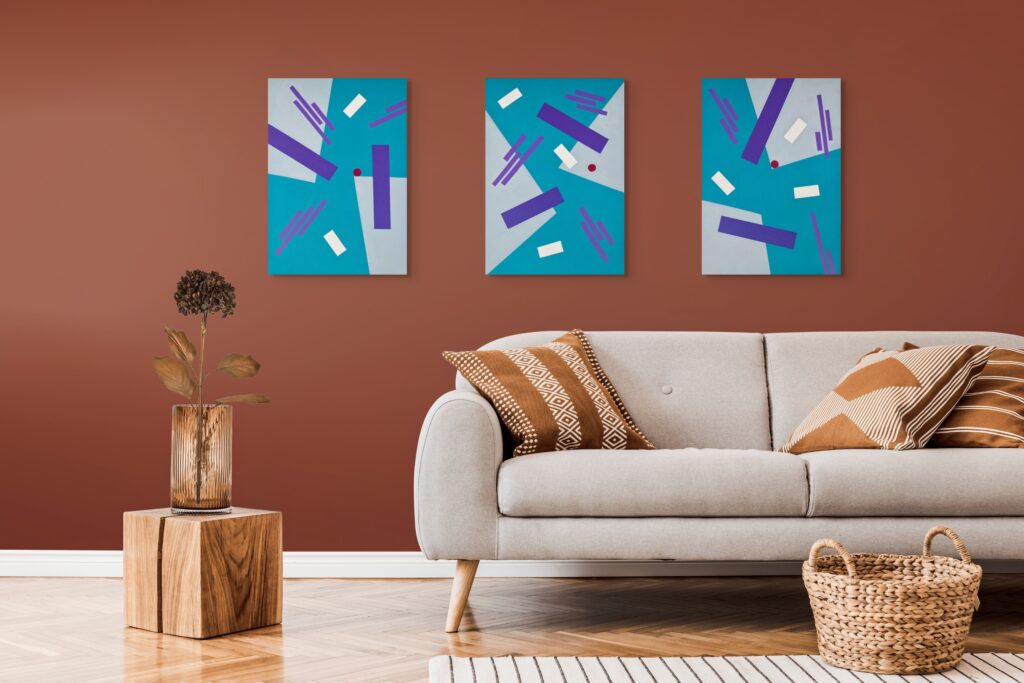
#2 Colour and Palette: Abstract Geometric Choices
Colour determines emotional impact.
#2.1 Saturated Tones
Bold geometric art often uses saturated tones – deep blues, terracotta, emerald, charcoal or crimson – to energise a room.
#2.2 Cooler Palettes
Cooler palettes (blues, greens, greys) promote calm and clarity, while warmer hues (reds, oranges, ochres) create warmth and dynamism.
#2.3 Black White Choices
For striking contemporary interiors, black-and-white geometric pieces offer dramatic contrast. Their impact relies on structure rather than colour, making them ideal for minimalist living rooms or spaces with layered neutral furnishings.
#2.4 Colour Accents
Rather than matching colours exactly, echo one or two tones from the artwork in smaller elements such as cushions, throws or a rug. For example, a painting featuring muted rust can be subtly reinforced with a cushion trim or ceramic accessory. This creates cohesion without turning the room into a colour-matching exercise.
Below you can find table presenting the colour and pallette considerations in geometric art:
Palette Type | Mood | Pairing Tips | Example Artists | Black and white | High contrast, striking, minimalist | Adds drama to neutral interiors | Bridget Riley, Frank Stella |
|---|---|---|---|
Bold primaries | Energetic, playful | Works well with mid-century or modern interiors | Piet Mondrian, Ellsworth Kelly |
Muted / natural tones | Calm, cozy | Complements Organic Modern and Coastal interiors | Agnes Martin, Sarah Morris |
Sunset / coastal hues | Relaxed, airy | Great for beach-inspired or serene living rooms | Coastal-inspired geometric prints |
With scale and palette considered, the final decision concerns material and finish – elements that influence both longevity and visual character.
#3 Materials and Framing for Geometric Art
Geometric art can be presented in several formats, each offering a distinct aesthetic:
- Canvas: Provides texture and depth, ideal for painterly abstraction. Stretched canvas (3–4 cm / 1.2–1.6 in deep) offers a contemporary, gallery-style look.
- Fine art paper: Delivers crisp detail and is well-suited to precise geometric line work. Requires framing behind glass or acrylic for protection.
- Metal or aluminium composite: Produces sharp colour vibrancy and a sleek, modern finish, particularly effective in minimalist interiors.
Short comparison of geometric art materials and its uses are presented in table below:
Material | Look and Feel | Durability | Colour and Finish | Ideal Use | Canvas (originals and prints) | Textured, tactile surface; painterly quality | High for originals; prints durable if archival | Vibrant colours, matte or satin finish | Statement walls, large-format pieces |
|---|---|---|---|---|
Paper prints | Smooth, flat surface; crisp lines | Moderate; must be framed for protection | Highly detailed, good colour accuracy | Medium to small walls, gallery walls |
Metal prints | Sleek, modern; reflective finish | Very high; resistant to fading and moisture | Bold, saturated colours; glossy finish | Contemporary or industrial interiors, kitchens, bathrooms |
When framing, slim black, white or natural oak frames complement most geometric compositions. For gallery walls, maintain consistency in frame finish to avoid visual clutter. Floating frames suit canvas works, while thin-edged frames enhance paper prints without overpowering them. Below you can find a table with a comparison of framing options for geometric art and its uses:
Frame Type | Aesthetic | Protection | Best For | Framed prints | Classic, refined | Protects edges and glass | Paper prints, small to medium pieces |
|---|---|---|---|
Wrapped canvas | Minimalist, modern | Canvas stretched over wooden stretcher; no extra frame | Large canvas originals or prints |
Floater frames | Contemporary, “floating” effect | Slightly raised, protects edges | Originals and gallery-style canvas displays |
Always check for archival, pigment-based inks and acid-free materials to ensure fade resistance. Quality prints should maintain colour integrity for decades when kept out of direct sunlight.
Ultimately, choosing geometric wall art is about combining proportion, palette and production quality into a cohesive decision. When these elements align, your statement wall will not only command attention – it will retain its impact for years to come.
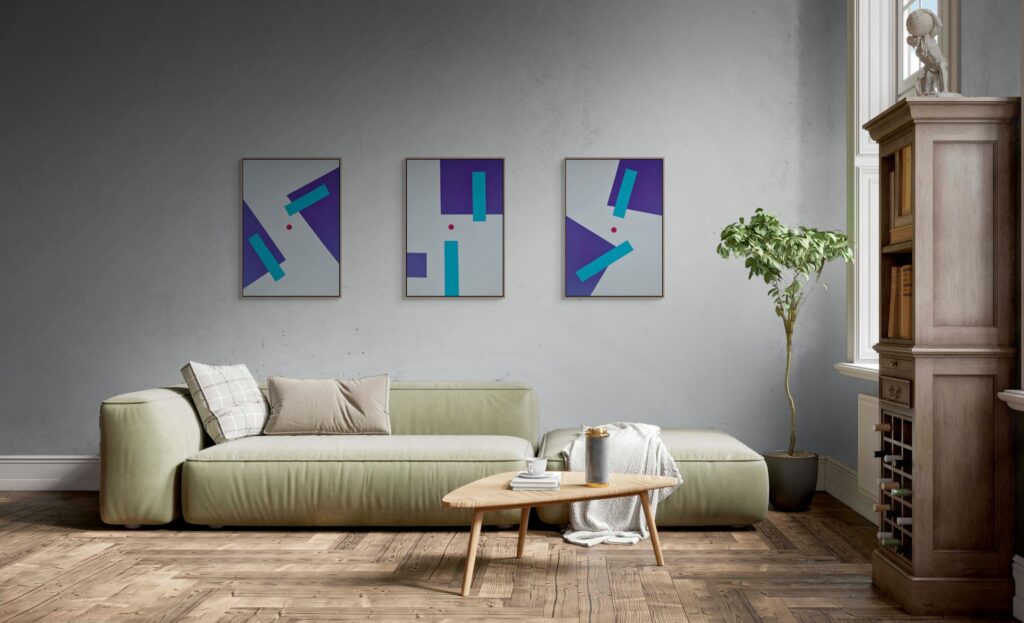
Discover the Joy of Closeness triptych by Adra, featuring Fluid Intimacy, Magnetic Drift and Quiet Embrace. It is a compelling choice for creating a striking geometric statement on your living room wall with expressive forms, variety textured layers and nuanced compositional depth added by non-figurative red dot.

Joy of Closeness: Fluid Intimacy

Joy of Closeness: Magnetic Drift

Joy of Closeness: Quite Embrace
Adding Texture to Geometric Art Displays
Incorporating texture into your geometric wall art displays is a powerful way to add depth and dimension to your living room. While geometric art is often celebrated for its crisp lines and bold shapes, pairing it with textured elements can transform a flat wall into a dynamic, multi-layered focal point.
Consider framing your geometric art with natural materials like wood to introduce warmth and tactile interest. A sleek black and white geometric print, for example, instantly feels more inviting when set in a rich oak or walnut frame. For a more contemporary edge, metallic accents, such as brushed brass or matte black metal, can echo the structured lines of your geometric art while adding a subtle sheen that catches the light.
Don’t overlook the impact of woven baskets, fabric wall hangings, or even textured wallpaper as part of your art display. These elements can soften the sharpness of geometric shapes, creating a harmonious balance between structure and comfort in your space. Layering different materials like canvas, metal, wood, and textiles brings a curated, designer feel to your walls and helps your art stand out as a true statement piece.
When selecting textured elements, always consider the overall interior design of your room. Match the frame or accent material to other finishes in your space for a cohesive look, and use colour to tie the display together. By thoughtfully combining texture with geometric art, you create a living room that feels both sophisticated and welcoming, with art that not only decorates but also enriches the atmosphere of your home.
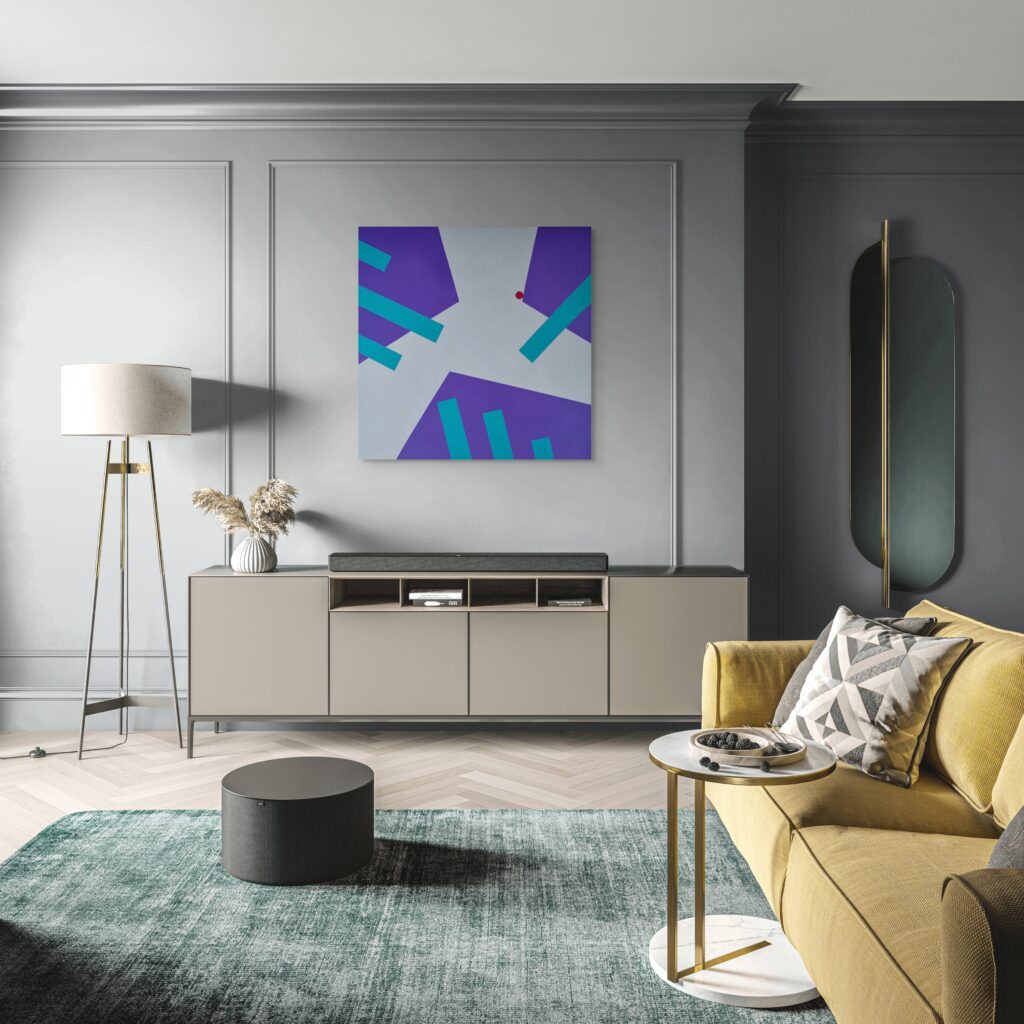
Balancing the Room with Bold Geometric Art
Introducing bold geometric art into your living room is a surefire way to make a statement, but achieving balance is key to a harmonious interior design. Start by selecting geometric art pieces that truly speak to your style, whether it’s a vibrant print featuring dynamic triangles and squares, or a striking black and white composition that commands attention.
To prevent your space from feeling overwhelmed, pair bold geometric art with more understated elements. A neutral-coloured sofa, a simple natural fibre rug, or minimalist decor can provide the perfect backdrop, allowing your art to shine without competing for attention. Consider the structure and layout of your room: position your statement piece where it can anchor the space, such as above the sofa or on a feature wall, and leave enough negative space around it to let the design breathe.
Harmony is achieved by filtering your decor choices and focusing on a few key elements. If your geometric art is colourful and energetic, keep surrounding accessories subtle and cohesive. If your artwork is monochrome, add warmth and texture through soft furnishings or wooden accents. Always consider the overall composition – balance strong shapes and colours with calm, open areas to create a sense of order and tranquility.
By thoughtfully integrating bold geometric art into your living room, you create a space that reflects your passion for design and your unique personality. The result is a perfectly balanced room where art, colour, and structure work together to make a confident, contemporary statement.
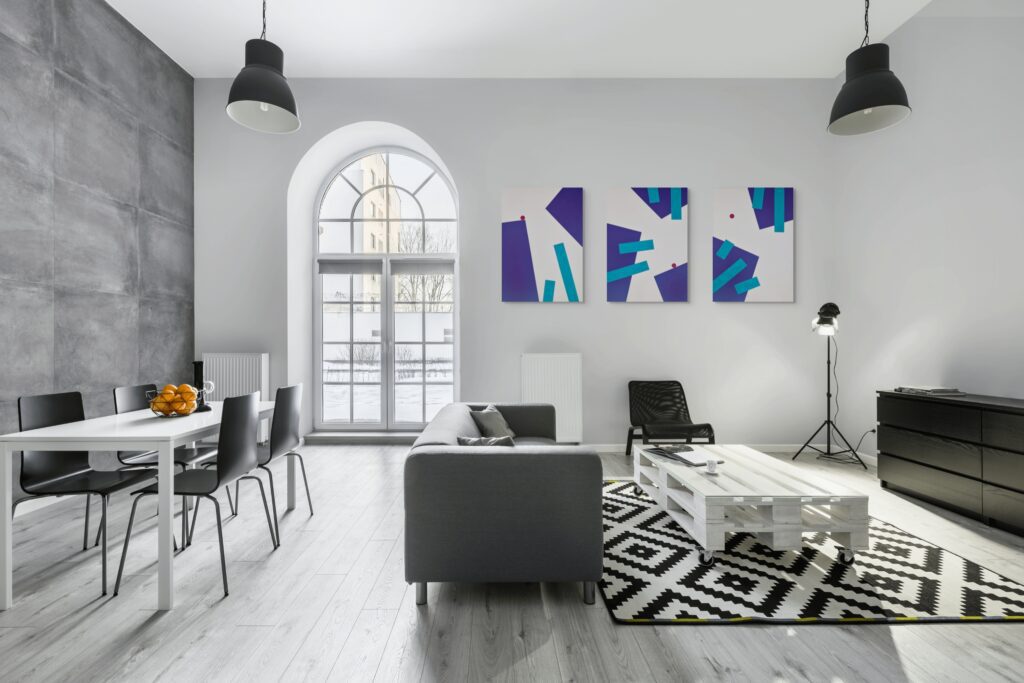
How to Choose Geometric Wall Art Collections
Not every large canvas creates a true focal point. Selecting geometric wall art that genuinely elevates your living room requires balancing emotional response, spatial harmony and long-term value.
A bold piece should feel intentional – not simply decorative.
#1 Personal Connection: Choosing Art for Living Room or Bedroom
Statement art must resonate with you personally. You will see it every day, often for many years. If the connection is weak, even the most technically impressive piece will eventually lose its appeal.
When considering geometric art prints, pause and assess your instinctive reaction:
- Does it energise the room?
- Does it create calm or clarity?
- Does it draw you in with movement or structure?
The right piece evokes an emotional response, not just aesthetic approval. This applies whether you are selecting art for a living room, a bedroom or any other room – the artwork should feel aligned with how you want the space to function.
Once that emotional connection is established, the next step is ensuring the piece works with your interior style.
#2 Room Compatibility: From Mid-Century Modern to Bohemian Interiors
Different interiors carry different visual weights, and your geometric art should complement, not compete with the setting.
In contemporary or minimalist spaces:
- Clean lines and open layouts can support larger, more dramatic works.
- Strong colour blocks and high contrast compositions perform particularly well.
- Simplicity in furniture allows the art to dominate confidently.
In traditional or transitional interiors:
- Choose structured geometric pieces with a considered palette.
- Avoid overly aggressive colour contrasts that may clash with period features.
- Opt for refined framing to integrate the artwork gracefully.
Colour compatibility is important, but matching is unnecessary. In fact, bold abstract art often works best in neutral rooms, where it becomes the primary colour statement.
For example:
- Black-and-white geometric pieces create impact through contrast and form alone.
- A single saturated tone within the artwork can be subtly echoed in cushions, throws or ceramics.
- Neutral geometric compositions rely on line and proportion rather than colour intensity.
Modern design principles favour allowing the artwork to act as the focal point while surrounding décor remains restrained. This balance ensures clarity rather than visual noise.
With style alignment confirmed, attention should turn to quality and longevity.
#3 Investing in Quality Geometric Art Collections
A statement piece is not a short-term trend purchase. It shapes your daily environment and deserves careful consideration.
When evaluating geometric art, prioritise:
- Strong, balanced composition
- Sophisticated and confident colour relationships
- Precision in line work and execution
- Archival-quality materials and inks
Geometric abstraction has enduring appeal because its mathematical structure transcends trends. From mid-century modern influences to contemporary minimalist interiors, its clarity remains relevant across decades.
When budgeting, consider the long-term value:
- High-quality large-format prints (120–180 cm / 48–71 in) typically range from £150–£600 (€175–€690 / $190–$750), depending on material and framing.
- Limited-edition prints offer exclusivity at a more accessible price point.
- Original paintings begin around £800 (€920 / $1,000) and increase with scale and artist recognition.
One exceptional piece of framed art will always have greater impact than multiple mediocre works. Think of it as an investment in atmosphere, mood and architectural coherence.
When chosen thoughtfully, geometric wall art does more than decorate it defines the living room and reinforces the confidence of your design decisions.
After planning and styling your geometric gallery wall, the next step is understanding the practical aspects of purchasing, including pricing, quality, and how to choose the right pieces for your space. Read about it in the next section.
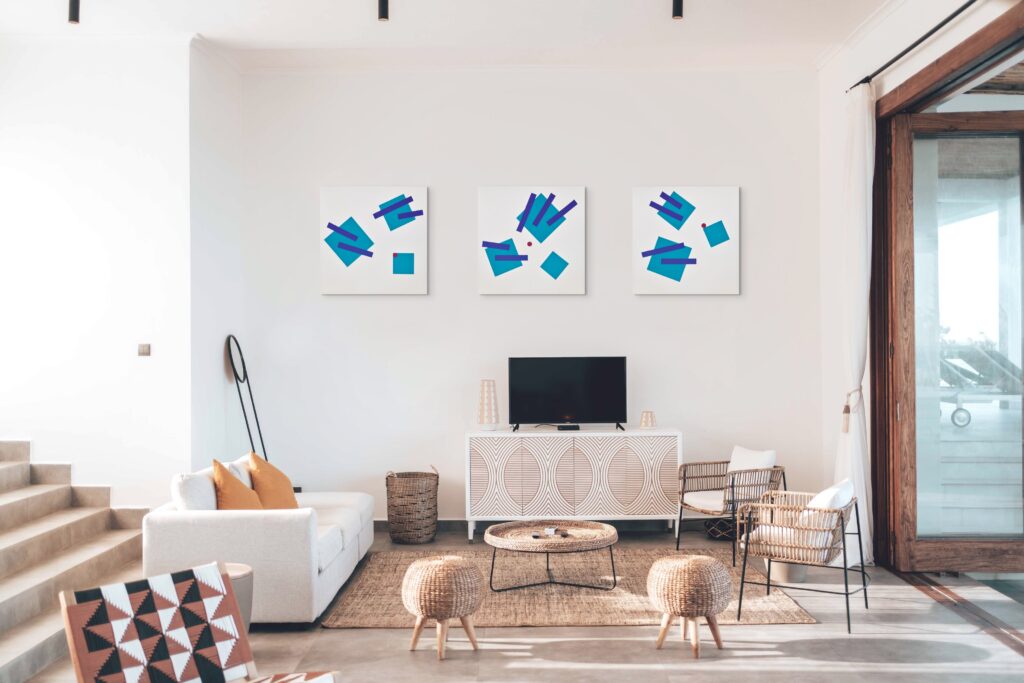
Building an Abstract Geometric Gallery Wall in the Living Room
A gallery wall allows you to introduce bold geometric art in a layered, curated way. Rather than relying on one oversized canvas, you create impact through composition, rhythm and proportion. When planned carefully, a geometric gallery wall feels architectural rather than chaotic.
Begin with structure.
- Anchor the arrangement with one larger central piece (for example, 90–120 cm / 36–48 in wide).
- Build around it using smaller works in varied sizes — such as 40 × 50 cm (16 × 20 in) or 50 × 70 cm (20 × 28 in).
- Mix vertical and horizontal orientations to create movement.
💡 Tip: Lay all pieces on the floor first and experiment with spacing before committing to the wall. Aim for consistent gaps of 5–8 cm (2–3 in) between frames.
To maintain cohesion:
- Keep a consistent frame finish (all black, all oak, or all white).
- Repeat at least one colour or geometric motif across several pieces.
- Avoid overcrowding – negative space is part of the composition.
A gallery wall also offers the opportunity to mix geometric abstraction with complementary works, which brings us to styling considerations for specific palettes.
#1 Styling Black and White Geometric Art in Contemporary Interiors
Black-and-white geometric art relies on contrast rather than colour. The visual tension between light and dark creates clarity, drama and strong architectural definition.
In contemporary interiors, monochrome works:
- Reinforce clean lines and minimal furniture silhouettes.
- Emphasise form and proportion.
- Deliver impact without introducing additional colour.
For a refined finish:
- Choose matte black or slim white frames for minimalist appeal.
- Avoid overly ornate mouldings that dilute the geometric sharpness.
- Consider museum-grade, non-reflective glass for paper prints.
However, an entirely monochrome scheme can feel stark. Soften it by introducing texture:
- Linen cushions
- Wool or boucle throws
- Natural timber furniture
- Ceramic or stone accessories
💡 Tip: Texture prevents black-and-white compositions from feeling clinical while preserving their bold contrast.
Once contrast is mastered, the next step is exploring how geometric art interacts with other interior styles.
#2 Mixing Geometric Art with Other Styles in the Living Room
Geometric art is remarkably versatile when paired thoughtfully.
With mid-century furniture:
- Clean-lined sofas, walnut sideboards and tapered legs complement structured geometric compositions.
- Earthy tones such as rust, mustard or olive work beautifully alongside abstract forms.
With organic or softer interiors:
- Combine geometric prints with curved furniture, natural fibres and plants.
- The contrast between structured lines and organic shapes creates visual balance.
To maintain harmony:
- Limit competing patterns (avoid pairing bold geometrics with busy florals or heavy stripes).
- Repeat one or two colours across art and textiles.
- Keep large furniture visually calm if the art is complex.
💡 Tip: Let one element lead, either the artwork or patterned furnishings, never both equally.
With style cohesion addressed, proper placement and lighting ensure the artwork performs at its best.
#3 Placement, Lighting and Installation in the Living Room
Even exceptional artwork loses impact if hung incorrectly. Precision matters.
#3.1 Hanging Height
For seating areas:
- Position the centre of the gallery arrangement at 145–150 cm (57–59 in) from the floor.
- Maintain 15–25 cm (6–10 in) between the sofa back and the lowest frame.
In taller rooms (3 m / 10 ft ceilings), slightly raise the composition while keeping visual connection to the furniture below.
#3.2 Lighting
Directional lighting enhances geometric clarity.
- Install adjustable wall-mounted picture lights above key pieces.
- Use ceiling spotlights angled at 30 degrees to minimise glare.
- Ensure each focal piece receives balanced illumination.
Warm white bulbs (2700–3000K) create comfort, whereas cooler light enhances contrast in black-and-white works.
💡 Tip: Lighting should highlight the artwork, not wash it out. That is why avoid placing art opposite large windows without considering glare.
#3.3 Hardware and Fixings
Always match hardware to artwork weight:
- Lightweight framed prints (under 5 kg / 11 lb): heavy-duty picture hooks.
- Medium pieces (5–15 kg / 11–33 lb): wall anchors or masonry plugs.
- Large canvases or multi-panel works (15 kg+ / 33 lb+): secure wall anchors or professional installation.
In plasterboard walls, use appropriate cavity fixings. For masonry or brick, drill with suitable wall plugs.
A carefully planned gallery wall, correctly scaled and properly installed, transforms geometric art into a structured visual statement. With composition, lighting and proportion aligned, your living room gains not just decoration, but architectural presence.
Buying Guide and Price Considerations for Geometric Wall Art
Choosing geometric wall art is both an aesthetic and practical investment. Beyond selecting a design you love, it’s wise to understand pricing, quality indicators and purchasing safeguards so you don’t regret your choice later. Many online art retailers now ship worldwide, making it easy to access geometric art collections regardless of your location.
#1 Typical Price Ranges
Artwork prices vary widely depending on size, medium and edition.
Geometric art prints are available in various sizes including mini, small, medium, large, and oversized. Colour combinations for geometric art prints can include black and white, blue and grey, and pink and grey. Geometric art prints can be framed in various styles including framed prints, wrapped canvas, and floater frames.
- Fine art prints: From around £80–£250 (€92–€288 / $100–$320) for standard sizes up to 60 × 80 cm / 24 × 32 in.
- Large canvas prints: Usually £200–£600 (€230–€690 / $250–$750) for statement formats (120–180 cm / 48–71 in).
- Limited‑edition prints: Often £300–£1,000+ (€345–€1,150+ / $380–$1,250+) depending on edition size, paper quality and framing.
Original paintings on canvas offer unique texture, depth, and one-of-a-kind visual impact for any space. Ogirinals are available in a range of sizes, from medium to large and oversized formats. Colour palettes can vary widely, from bold primaries to subtle neutrals, depending on the artist’s vision.
- Original paintings and premium canvases: Typically £800–£3,000+ (€920–€3,450+ / $1,000–$4,000+) based on artist stature and scale.
💡 Tip: Larger formats and limited editions are pricier but offer greater presence and often hold value longer.
#2 Verify Seller Reputation and Returns
Don’t rush a purchase without checking:
- Seller reviews – look at recent customer feedback.
- Return and refund policies – ensure you can return or exchange if the piece doesn’t suit your space.
- Delivery terms – oversized art may require specialist shipping.
Always confirm that return and delivery charges are reasonable, especially for large canvases.
#3 Try Before You Commit
Especially for large or expensive pieces:
- Request sample prints if available.
- Print posters at home to test scale on your wall.
- Use painter’s tape to mark the artwork’s dimensions on the wall before buying.
This simple step avoids costly returns and visual surprises.
Once you understand pricing, quality and purchasing considerations, the next section highlights a specific collection that exemplifies bold geometric design, described in detail: Adra Paintings’ Invisible Geometry series.
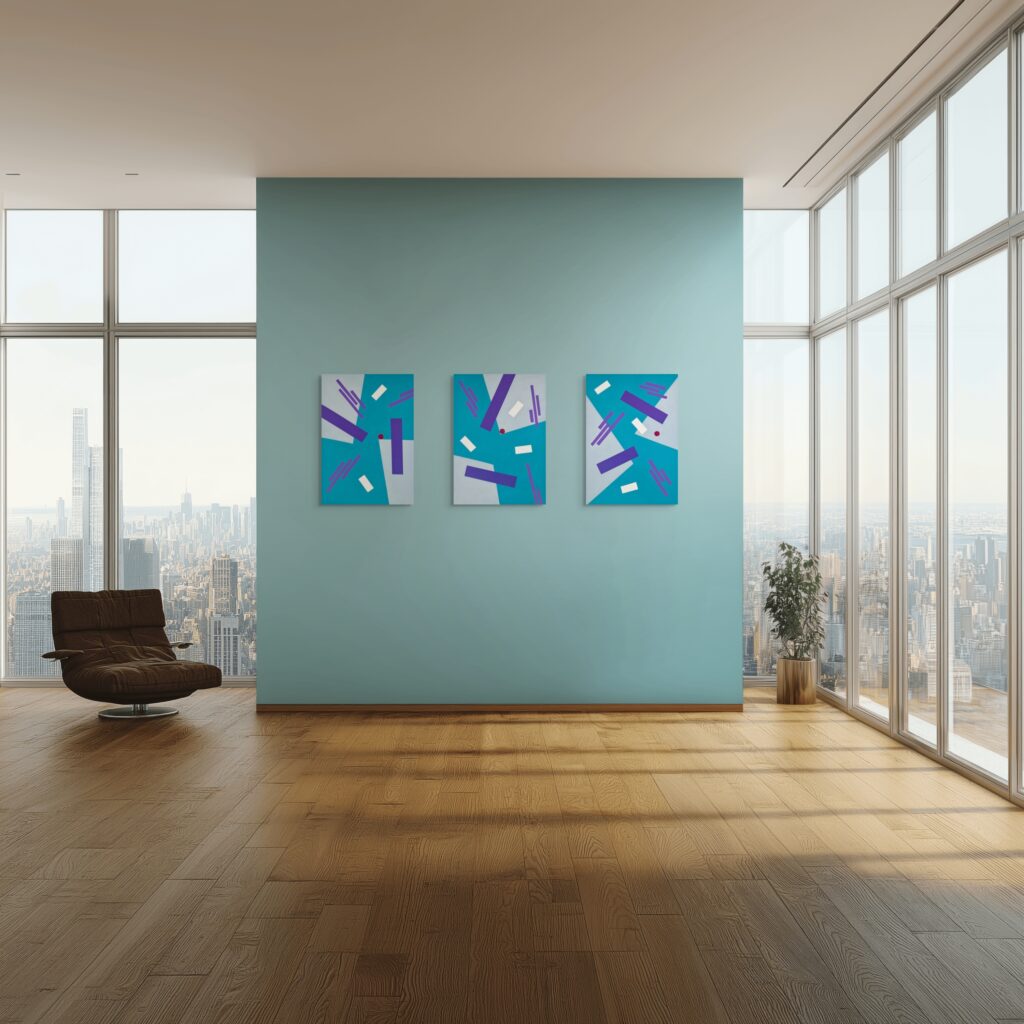
Adra Paintings – Bold, Geometric, Abstract Art Collection called Invisible Geometry
Adra’s geometric artworks are available as original hand‑painted paintings and museum‑quality canvas prints, giving you flexibility to choose pieces that best suit your living room or bedroom scale and style.
- Originals are one‑of‑a‑kind, expressive works created with layered acrylic on cotton canvas, each hand‑stretched and ready to hang.
- Canvas prints offer gallery-scale impact with vibrant colour and sturdy wooden stretchers, also ready to hang straight from the box.
Within these formats, the six series of the Invisible Geometry Collection can be grouped as triptychs or coordinated sets to create striking visual statements on feature walls or above sofas:
- Interplay Triptych – Exploring, Calling, Becoming: Reflects the dynamic dialogue between self and others. Energetic geometric forms convey curiosity, connection and personal growth.
- Balance Triptych – Embodies equilibrium and visual harmony, with poised geometry and nuanced colour relationships creating a sense of stability and measured rhythm.
- Gravity Triptych – Uplifting, Pulling, Propelling: Explores forces of movement and tension. Directional energy and balanced contrasts evoke momentum while grounding the space.
- Sensations Triptych – Sparks, Pulses, Echoes: Uses textured forms and layered colour to create visual resonance, rhythmic motion and tactile engagement.
- Playtime Triptych – Energetic, Bouncy, Adventure: Celebrates joy, curiosity and spontaneity. The geometric language conveys movement, resilience and playful exploration.
- Joy of Closeness Triptych – Magnetic Drift, Fluid Intimacy, Quiet Embrace: Focuses on presence, connection and mutual belonging. Gentle geometric forms carry an emotional narrative about empathy and relational openness.
Each triptych functions as a cohesive narrative in three parts, combining layered meaning with striking visual rhythm. Originals offer depth and texture, while canvas prints provide intense colour and durability for everyday viewing.
💡 Tip: These sets are perfect for creating a cohesive gallery-style composition, whether as a central focal point or arranged with complementary geometric works, enhancing both serenity and personality in the room.
🖼Quiz: Geometric Art for Living Rooms
Test your understanding of abstract geometric art for great rooms and living spaces.
Question 1 of 3
What is the recommended width of a statement piece above a sofa?
Which of the following is a defining feature of bold geometric art?
How does Coastal Geometric art relate to Organic Modern style?
Summary: Bold, Geometric Art for the Living Room
Geometric wall art transforms living rooms from ordinary to striking, creating focus, balance and personality. By considering scale, proportion, colour and composition, you can choose pieces that complement your space, whether a single statement canvas or a curated gallery wall. From selecting originals or high-quality prints to styling triptychs like Adra Paintings’ Invisible Geometry collection, thoughtful choices ensure your artwork resonates emotionally while enhancing the room’s architectural rhythm.
Ultimately, bold geometric art is not just decoration – it defines the space and elevates the atmosphere with clarity and confidence. By combining thoughtful scale, colour, composition, and personal resonance, geometric art becomes a statement that defines your living room by creating visual interest, harmony, and a confident, contemporary atmosphere.
Ready to Turn Your Blank Wall into a Bold Artistic Statement?
Transform Your Space with Uplifting Art
Browse my collection of mood-boosting geometric paintings.
FAQ - Frequently Asked Questions
For a sofa with a 76 cm (30 in) back, the art should start around 91–97 cm (36–38 in) from the floor.
The centre of the artwork should sit at roughly 145–152 cm (57–60 in) from the floor for optimal viewing from both standing and seated positions.
